
A college football Saturday now produces two sets of numbers. One is the sportsbook line. The other is a contract price set by traders, moving on injury news and weather until the game is settled.
Those are different products with different mechanics, different costs and different counterparties. This guide covers how event contracts work on a college football game, then walks through the six platforms listing them this season.
Key Takeaways
- An event contract is a position on a stated outcome that settles at a fixed value once the result is official, with the price paid determining the return.
- A contract price is read as implied probability, not as a forecast, and it moves until settlement.
- Fee schedules differ by platform and are charged on both the buy and the sell, so an early exit is taxed twice.
- Federal exchange oversight does not by itself establish that a product is available in every state.
How a College Football Event Contract Works
A game-winner market lists a team’s outcome as a tradeable position. If the outcome occurs the contract settles at its full value, and if it does not it settles at zero. Buying below full value and being correct produces the difference as profit, before fees.
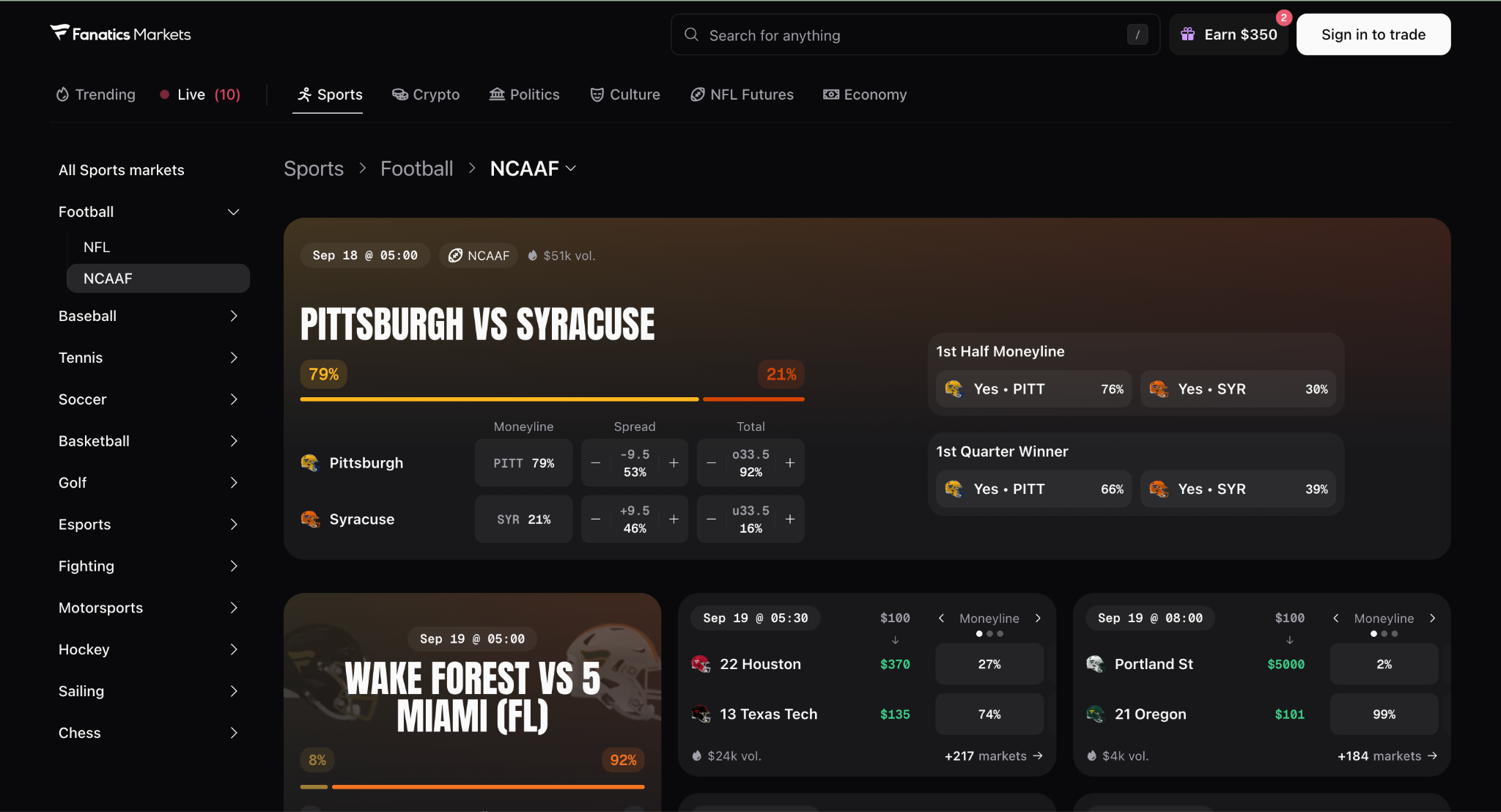
Reading the unit matters. Fanatics Markets prices contracts between $0.001 and $0.999 each in its published fee schedule, while its trading board displays markets against a $100 figure, which represents a hundred-contract position rather than a single contract. Confirm which unit a screen is showing before sizing an order.
Prices move on team news, and college football is harder to read than the pro game because injury-reporting practices are not uniform across programs. That unpredictability is the point of the category rather than a flaw in it, as anyone who followed [a chaotic race weekend](URL NEEDED) that made a mess of the pre-session favorites will recognize.
How These Platforms Were Compared
Each platform was checked against its own product pages, fee disclosures and public filings rather than aggregator summaries. Where sources disagreed on a detail, that detail was left out.
Three things were weighed. Whether the platform lists college football specifically rather than sports in general. The depth of markets available on a single game. And how clearly the platform documents its fees, its exchange structure and its risk disclosures.
State-level availability was deliberately excluded. That picture is changing across the category and each platform publishes its own current position.
College Football Prediction Market Platforms at a Glance
|
Platform |
College football coverage |
Notable for |
|
Fanatics Markets |
Full NCAAF board with 200-plus markets per game |
Published per-contract fee schedule, NFL and NCAAF pages |
|
Kalshi |
Sports contracts within a general-purpose exchange |
Long-running CFTC-regulated exchange, broad categories |
|
Polymarket |
Sports alongside politics, crypto and economics |
Implied-probability display, separate US entity |
|
FanDuel Predicts |
Sports contracts including football |
CME Group joint venture, financial and economic markets |
|
Robinhood Prediction Markets |
Sports contracts inside a brokerage app |
Contracts held alongside other account holdings |
The Platforms
1. Fanatics Markets
The NCAAF board runs the full weekend slate, with individual games carrying between roughly 185 and 210 additional markets beyond the headline result. Volume concentrates on ranked matchups, and the platform also runs a Live section for markets trading while games are in progress. The Fanatics Markets CFB odds page sits alongside a separate NFL page, so game-level and season-long football contracts are grouped rather than mixed into a general sports feed.
Costs are documented in detail. The fee disclosure, effective September 2, 2026, states a total trading fee of between $0.00034 and $0.02 per contract charged on each contract bought or sold, with fees highest on contracts priced near $0.50 and lower near either extreme. Single-contract orders round up to a one-cent minimum. ACH deposits are free while debit card, Apple Pay, PayPal and Venmo deposits may carry up to 2%.
2. Kalshi
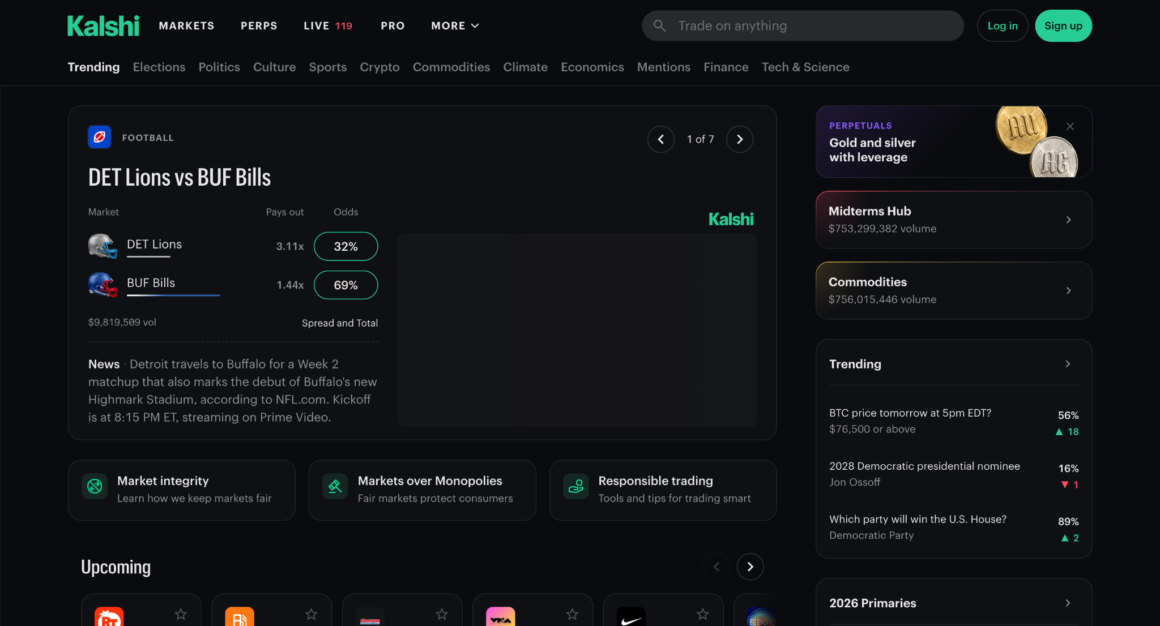
Kalshi is one of the longer-running CFTC-regulated event contract exchanges in the United States, and it describes itself as matching traders rather than acting as their counterparty. Sports sits as one category alongside politics, economics, climate, companies and culture.
Because the sports board sits inside a general-purpose exchange, contracts tend to be framed the same way as its political and economic markets. Check current college football listings directly, since a category page alone does not establish that a particular game is open for trading.
3. Polymarket
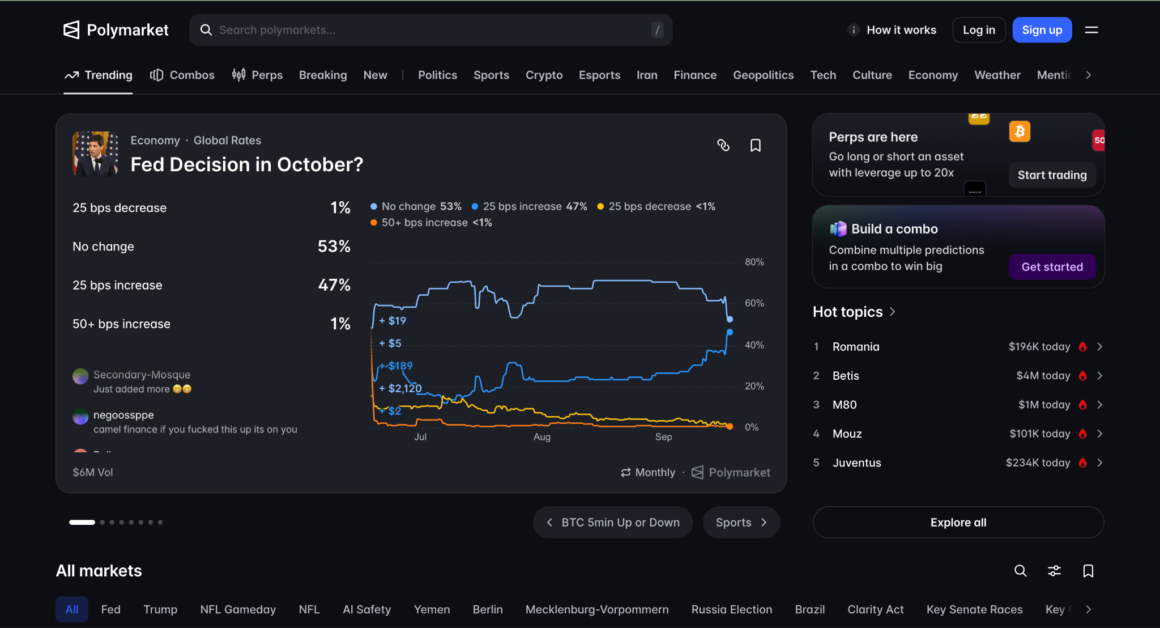
Polymarket runs a large global market catalogue with sports among its categories, and presents prices as implied probabilities that can be bought, sold or adjusted while a market remains open. New markets tend to appear quickly after a story breaks.
Domestic access runs through Polymarket US, which operates under a CFTC designated contract market licence held by QCX LLC. Its global catalogue and its US offering are not the same product, so confirm what is reachable before assuming a listed market is available.
4. FanDuel Predicts
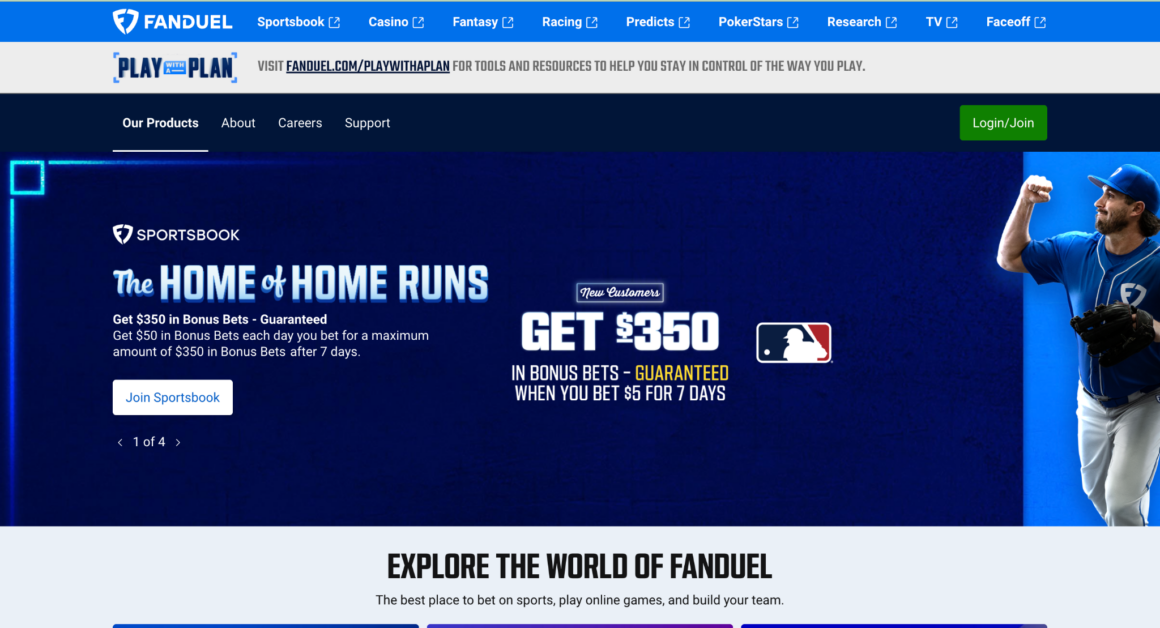
FanDuel Predicts is the app of FanDuel Prediction Markets, a joint venture between FanDuel Group and CME Group. Sports contracts cover football alongside baseball, basketball and hockey, with financial benchmarks and economic indicators in the same product.
Its exchange arrangement has shifted since launch. Sports and novelty contracts route through Crypto.com while financial derivatives remain with CME Group, and accounts are opened with FanDuel Prediction Markets LLC, a registered futures commission merchant and NFA member.
5. Robinhood Prediction Markets
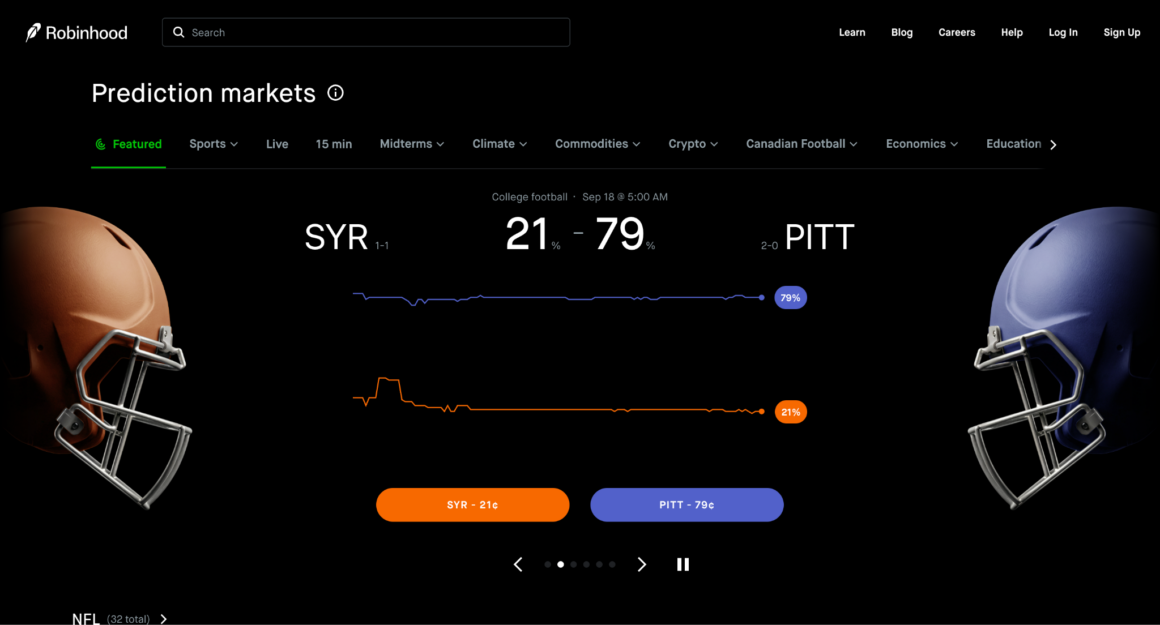
Robinhood added event contracts to its brokerage app and has expanded the category since. For existing users the appeal is keeping contracts in the same account as other holdings rather than opening a separate one.
Its infrastructure has changed as the category matured. Robinhood began by routing contracts through partner exchanges and now also operates Rothera, a CFTC-licensed exchange and clearinghouse run as a joint venture with Susquehanna International Group.
How to Read a Market Screen
Read the exact wording first. Winning a game is a different contract from winning a conference or a national title, and the settlement source named in the rules is what decides the outcome.
The displayed price may be the last trade rather than a price currently available. The bid is what a buyer offers and the ask is what a seller wants, and the gap between them is the spread. If the bid is 69 cents and the ask is 72, buying at 72 and selling immediately at 69 loses three cents per contract before fees.
Available size shows how many contracts can trade at a quoted price. A larger order may fill across several prices or remain partly unfilled, which is why liquidity matters most when you want out early rather than when you enter.
A Pre-Trade Checklist
- Read the exact outcome, the settlement source and the cancellation rules.
- Check the bid, the ask and the available size rather than the headline price alone.
- Calculate fees on both the buy and the sell if you may exit before settlement.
- Confirm platform eligibility and minimum age requirements for your state.
- Check when the lineup or weather information you are acting on was published.
- Set an amount you can afford to lose in full, including fees.
An order at your chosen price may not fill, and an early sale is not guaranteed. Treat embedded scores and live data as informational, since the source named in the contract rules is what governs settlement. As with any market, the [prediction is harder than it looks](URL NEEDED) once the variables start moving.
Where the Rules Stand
US sports event contracts operate within an evolving regulatory and legal landscape. Federal exchange oversight does not by itself establish that a product is available in every state.
Morton St. Trading Investments, LLC, doing business as Fanatics Markets, is a CFTC-registered futures commission merchant and NFA member, with contracts offered through Crypto.com | Derivatives North America under Nadex rules. Trading event contracts involves significant risk and is not appropriate for everyone, and past performance is not necessarily indicative of future results.
Review current disclosures and eligibility notes before trading rather than assuming last season’s terms still apply.
FAQ
- Are college football prediction markets legal in the US? Some US platforms offer sports event contracts through CFTC-regulated exchanges, but access is not uniform nationwide. Check current state availability and platform eligibility requirements directly.
- Can I sell before a game ends? Only if trading remains open and a buyer accepts your price. You may have to sell for less than you paid, or be unable to sell at all.
- How many markets are listed on one college football game? On the deepest boards, a single game can carry more than two hundred markets covering in-game and player outcomes alongside the game winner.
- What market types will I see? Game winners, conference champions, national champion contracts and awards markets such as the Heisman Trophy where offered. Season-long contracts can tie up funds for months if no buyer is available.