
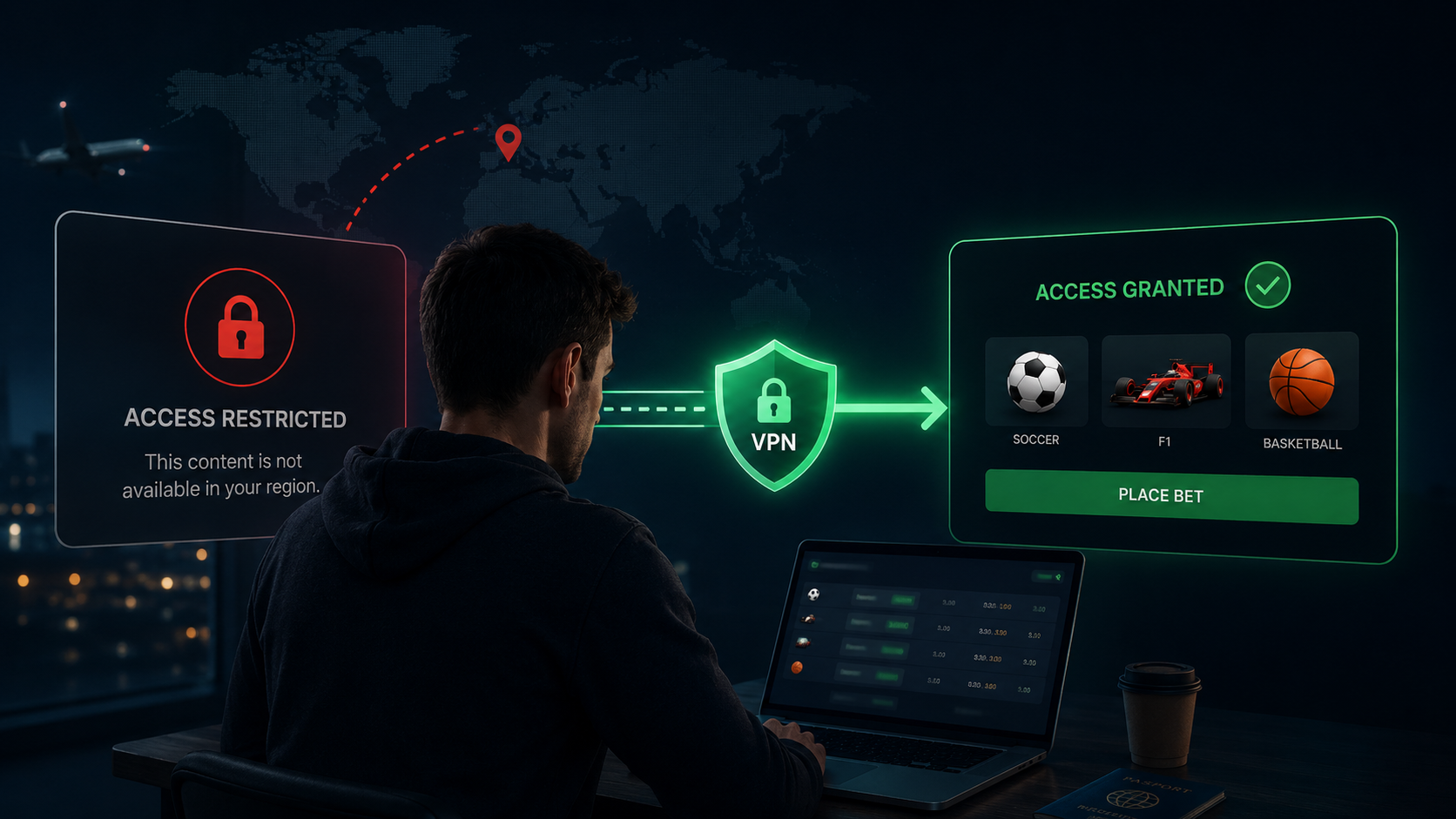
Picture this. It's Monaco Grand Prix weekend, or maybe the World Cup group stage, and you're traveling, or you've moved abroad, or your home country just decided sportsbooks aren't allowed to operate there anymore. You open the app you've used for years and get a message that basically says: not here, not for you. Millions of sports fans hit that wall every year, and a good chunk of them have figured out the same workaround.
A VPN doesn't just unblock Netflix libraries. For sports bettors, it's become the single biggest lever for getting access to better markets, better odds, and sportsbooks that simply don't operate, or don't operate well, in their home country.
Table of Contents
ToggleThe Real Reason Odds Differ So Much Between Regions
Every sportsbook sets its own lines, its own vig, and its own market depth. A book licensed and optimized for the US market might carry weak coverage on, say, Bundesliga or NHL futures, while a crypto-native operator built for a European and Asian audience runs tighter lines on exactly those markets. This isn't a conspiracy, it's just how liquidity and regulation shape a product. But it means the fan who can only access whatever sportsbook their home country allows is often getting worse pricing than someone one VPN connection away.
That gap is exactly why VPN-friendly sportsbooks have become such a specific niche of the betting world. Sites like Betplay.io, FortuneJack and BetOnline show up again and again on VPN-tolerant shortlists precisely because they don't block connections the moment a VPN exit node lights up, and their odds on international markets, especially soccer and combat sports, tend to be sharper than what a geo-restricted local operator offers.
VPN Friendly and VPN Tolerated Are Not the Same Thing
Here's where a lot of bettors get burned. A sportsbook can let you register and deposit through a VPN just fine, then flag your account the moment you try to withdraw a meaningful win. That's not VPN friendly, that's VPN tolerated until you become inconvenient, and the distinction matters enormously if you're actually planning to cash out.
VPNCasinos built an entire grading system, the Anonymity Grade, specifically to separate the two. VPN Access Policy and KYC Policy each carry 40 percent weight, with AML transparency making up the remaining 20 percent, and testing runs across multiple VPN providers and exit countries rather than a single quick check from one location. A sportsbook that works from a US IP but breaks the moment you switch to a UK or Canadian exit node doesn't score well, no matter how good the marketing copy sounds.
The practical difference for a fan chasing better lines: a book explicitly allowing VPN use in its terms and confirmed stable across repeated tests is a genuinely different risk profile than one that simply hasn't gotten around to blocking VPN traffic yet.
What Actually Changes When You Use One
Beyond dodging a geo-block outright, a VPN unlocks three things sports bettors specifically care about. Lower vig on markets that your local operator doesn't prioritize, since plenty of offshore and crypto sportsbooks run leaner margins than heavily regulated domestic books. Access to sports and leagues your home market simply doesn't offer, whether that's obscure European football divisions, darts, or niche combat sports circuits. And for crypto bettors specifically, the ability to reach no-KYC or light-KYC operators that let you deposit and withdraw with minimal friction instead of the standard ID-and-proof-of-address gauntlet.
None of this is without risk, and it's worth saying plainly: using a VPN can violate a sportsbook's terms of service even where it isn't illegal, and the consequences if a book decides to enforce that range from a restricted account to voided winnings. It's rare, but it happens, and it happens more often at heavily regulated fiat books than at the crypto-native operators built with VPN traffic in mind from day one.
Latency Actually Matters More Than People Think
One detail that gets skipped in most "how to VPN your way into a sportsbook" content: live betting is genuinely sensitive to the extra network hop a VPN introduces. Pre-match bets don't care about an extra 40 milliseconds. In-play markets absolutely do, especially on anything fast-moving like tennis or basketball, where a line can move before a slow connection even finishes loading the bet slip. Fans who live and die by live betting should be picking VPN providers with servers close to their target sportsbook's infrastructure and testing actual in-play performance before relying on it during a big match.
The takeaway for anyone tired of hitting a blackout screen during a major event: the workaround exists, it's mainstream at this point, and the sportsbooks worth using it on are the ones that are upfront about allowing it rather than the ones that quietly tolerate you until the day you actually win.