
College basketball roster building has changed dramatically in recent years. The transfer portal, the NCAA’s Name, Image and Likeness rules and the introduction of direct athlete compensation have created a more competitive, and considerably more expensive, recruiting environment.
For the University of North Florida, the challenge is clear. The Ospreys need to attract and retain enough talent to compete in the ASUN without attempting to match the financial resources of the biggest programmes in Division I basketball.
Bobby Kennen will oversee that process as North Florida prepares for the 2026–27 season. Kennen served as the programme’s interim head coach during the 2025–26 campaign before UNF removed the interim title and appointed him as its permanent head coach in March 2026.
Having worked at North Florida since 2009, Kennen is already familiar with the programme, its recruiting territory and the limitations facing a mid-major school in the modern college basketball market.
His task now is to build a more competitive roster following a difficult first season in charge.
North Florida’s Financial Challenge
The modern transfer portal gives coaches access to a large pool of experienced players, but proven Division I talent can be expensive.
North Florida must often compete against universities with larger athletic budgets, stronger donor networks and greater national exposure. Those programmes may be able to offer players more financial support, better facilities or a clearer route to major postseason competitions.
That financial imbalance is not limited to recruiting. College sports are part of a much wider commercial industry supported by broadcast agreements, sponsorships, ticket sales and digital media.
Sports audiences also increasingly overlap with betting and gaming coverage, including content about brands such as the BetUS casino. However, the commercial revenue generated around major college programmes is not distributed evenly across Division I.
North Florida therefore needs to be selective. Attempting to win every recruiting battle by making the largest financial offer would be neither realistic nor sustainable.
A Difficult First Season Under Kennen
The Ospreys finished the 2025–26 season with a 7–25 overall record and went 5–13 in ASUN play.
Those results demonstrate the scale of the rebuilding job facing Kennen and his staff. North Florida needs to improve its depth, consistency and ability to compete throughout the conference schedule.
The poor record also means that it would be premature to describe the programme’s recruitment strategy as a proven success.
However, UNF’s decision to appoint Kennen permanently provides a degree of continuity at a time when college basketball programmes can experience major changes every offseason.
Rather than beginning again with another coaching transition, North Florida has given Kennen the opportunity to reshape the roster and establish a longer-term direction.
Recruitment and Retention Must Work Together
Recruiting new players is only one part of the challenge.
North Florida must also retain the athletes it develops. A player who performs well for the Ospreys may quickly attract interest from larger programmes offering more money, more exposure or the possibility of competing at a higher level.
That creates a difficult balance.
Using too much of the available financial support to retain current players may restrict UNF’s ability to strengthen the roster. Spending too aggressively on transfers, meanwhile, could leave the programme unable to keep its most important returning athletes.
North Florida must therefore decide which players form the core of the team and which roster needs are best addressed through external recruitment.
Money will be an important factor, but it will not be the only one. Playing time, relationships with coaches, player development, academic support and a clearly defined role may also influence whether an athlete chooses to remain in Jacksonville.
For a mid-major programme, that sense of stability can be a valuable recruiting and retention tool.
A Mixed Recruiting Approach for 2026–27
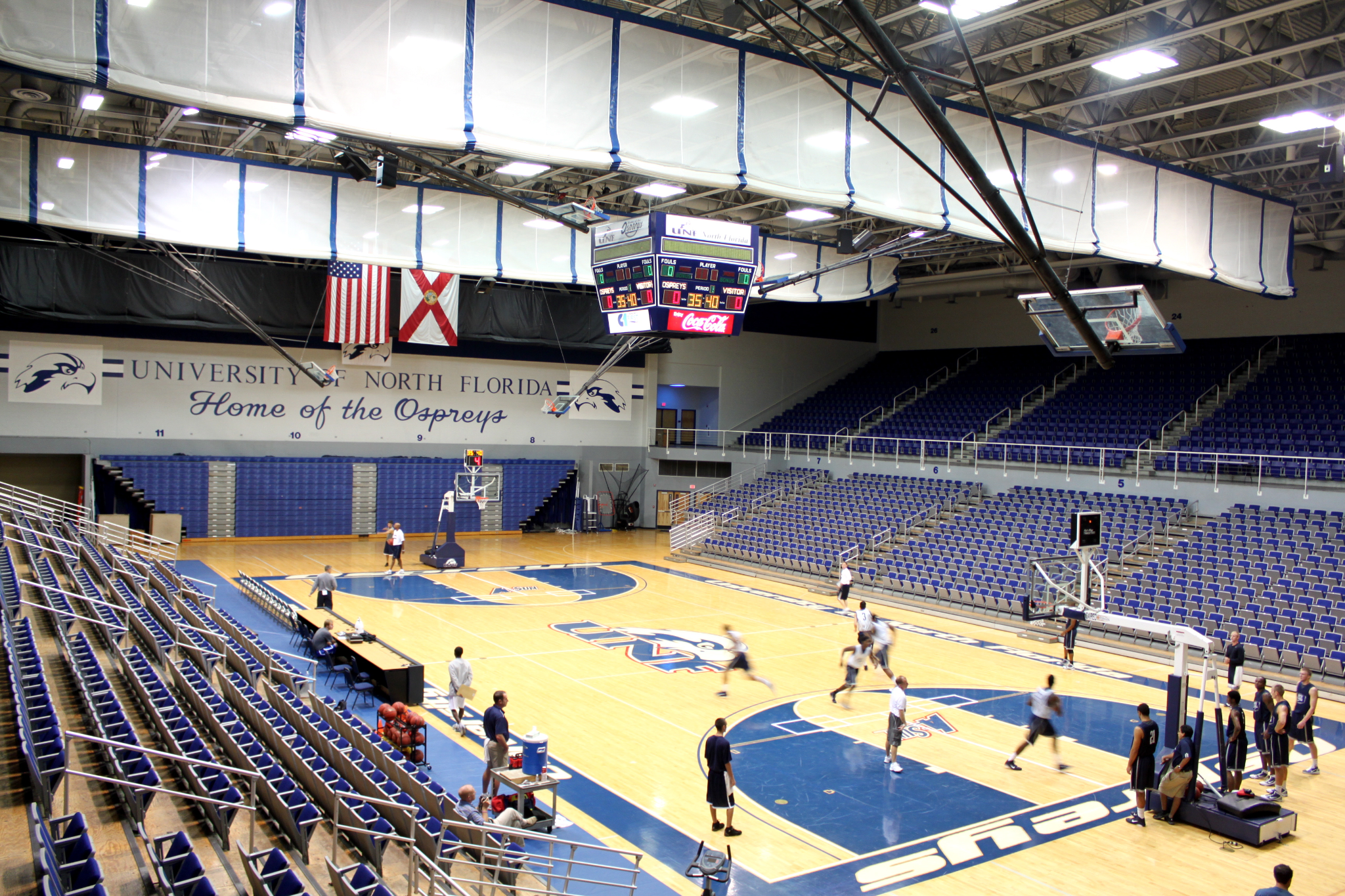
“UNF Arena Inside”
North Florida’s 2026–27 roster shows that Kennen is not relying on a single source of talent.
The Ospreys have brought in players from other Division I programmes, junior colleges and high schools. This gives the coaching staff a mixture of experience and developmental potential.
Among the most experienced additions is Eddie Placer, a 6-foot-5 guard who joined UNF after playing at Wagner. Placer appeared in 30 games during the 2025–26 season, made 14 starts and averaged 8.5 points per game.
Elijah Elliott transferred to North Florida after playing at Ohio, while 6-foot-9 forward Ayuba Bryant Jr. arrived from Temple.
The Ospreys have also added Hedrens “Jr” Bartelus from Chipola College, providing another route to finding players with experience beyond the high-school level.
At the same time, North Florida continues to recruit younger prospects. The incoming high-school group includes Ethan Bergantino, Isaiah Brown, Christopher Perry and Asa Kohn.
The result is a roster constructed from several different recruitment channels rather than one built entirely through the transfer portal.
Why High-School and Junior-College Recruitment Matters
Experienced Division I transfers can make an immediate impact, but they are often among the most heavily recruited players available.
High-school and junior-college prospects may offer North Florida a more sustainable alternative.
Junior-college players can bring maturity and experience without necessarily attracting the same financial offers as established Division I transfers. High-school recruits give the coaching staff more time to develop athletes within its own system.
There are still risks.
Younger players may need time before they are ready to contribute consistently. If they develop quickly, other programmes may attempt to recruit them through the transfer portal.
Even so, abandoning developmental recruitment would make UNF increasingly dependent on a transfer market in which it cannot consistently outspend its competitors.
A balanced strategy allows North Florida to add selected experienced players while continuing to identify prospects who could grow into larger roles.
The Importance of Player Development
Recruiting overlooked talent only works if the programme can develop it.
North Florida needs to show that players can improve during their time with the Ospreys, earn meaningful roles and prepare for opportunities beyond college basketball.
Development can also support retention. Players may be more willing to remain with a programme when they trust the coaching staff, understand their role and believe they are continuing to progress.
This is where Kennen’s long association with North Florida could be valuable. He understands the programme’s playing style and has established relationships within the university and the Jacksonville basketball community.
The challenge will be turning that familiarity into measurable progress on the court.
Can North Florida’s Strategy Work?
North Florida’s approach appears reasonable for a programme operating outside college basketball’s wealthiest conferences.
The Ospreys are combining returning players with experienced transfers, junior-college additions and high-school recruits. That gives them multiple ways to improve the roster without becoming entirely dependent on expensive transfer-portal targets.
However, a logical strategy does not guarantee results.
The new players must adjust to the programme, the coaching staff must establish a reliable rotation and the Ospreys must improve significantly after winning only seven games last season.
UNF must also prove that it can retain the players it successfully develops. Discovering overlooked talent provides limited long-term value if those athletes leave after one productive season.
The 2026–27 campaign will therefore be an important test of Kennen’s roster-building approach.
North Florida cannot control how much larger programmes are prepared to spend. It can control how carefully it evaluates players, how effectively it develops them and whether it creates an environment in which athletes see value in staying.
For the Ospreys, that may be the most sustainable way to compete in the modern NIL and transfer-portal era.